Jeffro's Space Gaming Blog

Microgames, Monster Games, and Role Playing Games

Monthly Archives: September 2015

Appendix N: I’m Telling You, Something Happened!

Three more data points for your consideration here.

The first from Sarah Newton:

It’s recognisably the same game, with that very specific T&T fantasy vibe (very swords and sorcery, much more Fafhrd and Conan than D&D’s slightly more po-faced Tolkienery), yet with a rules set that was quite revolutionary even back in the 1970s, when, to be honest, we didn’t really realise quite how revolutionary it was.

T&T has retained its pulp fantasy flavor while D&D has been successively reinterpreted so many times it has very little in common with its own literary antecedents.

Something happened. OD&D and T&T were both the product of the same literary inspirations. They both, for instance, treat Jack Vance and de Camp & Pratt as authoritative in ways that do not come naturally to children of the eighties or to people whose views of fantasy are strongly colored by the Sword or Shanarra/Thomas Covenant/Dragonlance/Forgotten Realms/Wheel of Time school of thinking. But even playing the most recent edition of T&T, you get the same pulp fantasy flavor that Gary Gygax prized so highly.

And about Gary Gygax…. Was his taste in science fiction and fantasy all that offbeat? It is now, certainly. But check out these recordings of the Mind Webs radio segments that began in the seventies. They’ve got Appendix N authors Philip José Farmer, H. P. Lovecraft, Roger Zelazny, Fritz Leiber, Fredric Brown, Poul Anderson, Stanley Weinbaum, Jack Williamson, and Fred Saberhagen right in there with all the other greats, giants, and grandmasters that are far more recognizable to present day fans.

Would those guys make it into a similar series begun in this century? Not likely. Because something happened. Maybe the publishers’ decision to drop Fritz Leiber’s back catalog in the mid-eighties explains his lapse into obscurity and maybe it doesn’t. My question is, who decided to retire/exclude/drop/exile/excommunicate Stanley Weinbaum from these sorts of things…? Is his work any more dated or any less original now than it was in the seventies…?

But now you’re like, “hey… calm down Jeff. You’re raising your voice over something trivial.” The maitre d’ is prepping his “excuse me, sir” speech. But I’m telling you something did happen in both science fiction and fantasy. And I’ll tell you how I know it happened, too: because it didn’t happen in the time travel subgenre. Check out the literary inspirations list to GURPS Time Travel. Look at how Poul Anderson and a whole raft of the usual suspects are still authoritative both there and in GURPS Infinite Worlds. Do you see what I’m talking about…? Do you?!

But excuse me for a moment, here. Someone’s come over to my table to speak to me…!

Blog Watch: Making 5e Old School, Traveller Advancement, Religious Magic, and Dragon Inflation

Movies (The Escapist) Inside the Lost Dragons Movie Gary Gygax Loved — “None of the main characters wields a weapon, casts a spell, picks a lock, uses a magic item, or indeed does much but flee danger. Aside from Tom taking the ruby, they resolve problems only by praying to the Onelord. You don’t feel like they are player characters, you feel like they are spectators, just watching powerful forces play out, which is exactly the opposite of playing Dungeons & Dragons. It reads like a children’s fantasy book where everyone depends on the grown-ups: more of a Narnia than, say, than a Lankhmar, but even Aslan makes you fight your own battles.”

D&D (Cirsova) 5e to OSR/Old School Conversion PDF — “I’ve seen some folks say that they haven’t seen any good simple supplements or 5e conversions for those looking for a more ‘Old School’ experience. So, I’ve put together a quick reference sheet for 5e players looking for a more Old School experience. I hope this helps.”

Traveller (The Ongoing Campaign) A Traveller Misconception And Describing The Structure Of Play — “Despite there being a clearly-labeled section on the topic, there’s a misperception that CT doesn’t allow characters to become any better than they were at the end of character creation. The problem is actually that players have become so attached to the idea that characters advance due to their success (or fail to advance due to their lack of success) that they miss the simplicity of the CT system.”

RPG Design (Zak S) Old School Design and Room In the Margins — “This game has Margin. And it’s not like I had to write up things either, like I would with modern supposed-to-be-generic systems. Because the core of the game is simply ‘What describes things that exist in this place and time?’ rather than ‘What is genre-appropriate?’ Cthulhu characters exist in a world that still has a lot of things that, thematically, aren’t horror-specific like cars and botany. And it grasps that you’d like to be able to play lots of sessions–either lots of different kinds of games, or lots of the same campaign but with evolving roles and situations, so it needs to weigh things players can do close to equally. Other trad systems think the same way–D&D, Warhammer, even FASERIP can all drift away from their default modes with barely an effort.”

Censorship (Greyhawk Grognard) Thoughts on the OBS Offensive Content Policy — “The question becomes, as they already have a history of caving into political pressure on social media, what guarantee do publishers have that, even after a title has been ‘whitelisted’, there won’t be a continuing campaign to apply pressure to OBS, which eventually results in the title being re-evaluated and banned? The answer is that there is no guarantee at all. If Fred Hicks, or Cam Banks, or some other prominent SJW, decides he doesn’t like a title, or an author, or a publisher, or an artist, then he already knows all he needs to do is keep jumping up and down about it, and OBS will roll over and show him its jewels. They’ve done it twice do far. No reason to think they won’t do it again.”

D&D (Searching For Magic) Religious Magic in RPGs — “The idea of gods showing up, messing about with human affairs and having the odd affair of their own to create demigods has a certain quality to it, but it disrupts the idea of faith. Faith, by definition, is a belief in something without proof. There’s no faith involved with fantasy religions. They are more like corporations with clearly defined goals based on the godly portfolio coming down from head office.”

Movies (SuperversiveSF) Is Khan a Villain? — “Khan is a moral force. He is destructive, and willful, but he acts with a purpose in mind. Khan did far more to stop war than Kirk did. If Khan had not rebelled against Marcus, then Kirk and others may have loyally followed Marcus into war. In contrast to Khan, Kirk rarely understands what will be the consequences of his actions. I submit that this makes Kirk a poor hero, and Khan far less than a villain.”

Books (Black Gate) The Public Life of Sherlock Holmes: Tolkien’s Necklace of the Dwarves — “The Nauglamir is the stuff of an absorbing novel, with elves, dwarves, greed, treachery, romance, heroes and villains, combat: and this is just one little bit of The Silmarillion. And a part of it is just a fragment of Beren’s life (there’s a tale for another novel or two)! I’m not crazy about the creation aspect at the beginning of The Silmarillion, but if you like history, the rest of the book is a fascinating read on a grand scale.”

SE4X (Board Game Geek) Research Centers: Yay or Nay? — “For those who love advanced planning, facilities were meant as a starting point. In the second expansion, I originally planned on adding at least one additional facility – the supply facility. It generates supply points that are used to pay your maintenance. These points actually are generated and sit on the map. A Supply Tech would have been added to the research tree that limited how far ships could be from a supply source to draw supply. As you researched the tech, the distance would get farther. Scouts and Raiders would have been allowed to draw supply from an unlimited distance, befitting their purpose. Transports could also carry supply for distant fleets. A fourth facility was also under consideration.”

D&D (Semper Initiativus Unam) More Dragons in the Dungeons — “Dragon inflation has been a constant of D&D, and it has slowly pushed the dragon out of the game, except at high levels. Dragons went up in hit points significantly in the first edition PHB, and much further in second edition, firmly ensconcing them as upper-echelon enemies. They have stayed that way ever since; a party will pretty much have to be 5th level or higher before even thinking about slaying a dragon.”

D&D (Monsters & Manuals) The Hickman Revolution and the Frustrated Novelist — “There is a reason why Hickman’s approach chimed with many gamers, and why ultimately it came to dominate the hobby during the 80s, 90s and 00s before story/hipster/forge games and the OSR began to slay the beast: many, I would say perhaps the majority, of GMs are frustrated novelists, just like Tracy Hickman was. To them, there was an allure in the idea that they could create games which were not mere games (a frivolous pursuit) but which were also stories – it was an outlet for their desire to be writers, which they could not fulfil due to lack of talent, time, dedication or all three.”

Hok the Mighty Link Roundup

The impression that the book stores and libraries and reading lists and talk and comment and news stories give you is that the pulp era only produced a handful of grandmasters: Tolkien, Lovecraft, Howard on one hand and Asimov, Heinlein, and Clarke on the other. The reality is that there were scads of forgotten writers that produced top quality stuff. The gap between the canonized giants and these other guys wasn’t as great as you’ve been lead to believe. In fact, for people that were fans of fantasy and science fiction back in the sixties and seventies, it’s the writers we consider to be grandmasters today that were liable to be considered second rate back then!

This wouldn’t matter, but it becomes a serious problem when people try to criticize the work of rpg designers that was produced in the seventies. We look at it and project our view of fantasy back onto them when they were in fact very much different from us in their tastes and assumptions. It’s nearly impossible for some people to imagine, but Poul Anderson and Michael Moorcock loomed far larger in their imaginations than they do in ours! And just as we saw with something as insignificant as an oddball monster from the Fiend Folio… it was possible for creators to produce things without a notion or care for the things we think of as being iconic or otherwise defining an era.

A lot of people will smugly look back on these people and dismiss them as being a product of their time. What we don’t realize is the extent to which we are a product of ours! So my recommendation is to go back an look at the writers that narrowly missed the cut for achieving grandmaster status. You may well find a kindred spirit that will blow your mind in ways you never anticipated. And Manly Wade Wellman just might be “that guy” for you.

RETROSPECTIVE: Battle in the Dawn by Manly Wade Wellman

Grognardia — “I have little doubt that the idea of a fantasy tale starring a prehistoric man seems strange to a lot of people, even uninteresting. The truth is that Wellman is a terrific writer, superb not only at creating compelling characters but at weaving history, folklore, and imagination into a delightful pulp adventure, just as he did with his stories of Silver John the Balladeer. Wellman isn’t as widely known an author as he ought to be, though Gary Gygax lists him in Appendix N as having had an influence over AD&D and Karl Edward Wagner (creator of Kane) was also a great admirer of his work.”

Tor.com — “While he’s a better writer, on a technical level, than either Howard or Lovecraft – Wellman has a masterful command of language and syntax, and shows a Mark Twain-esque facility with diction and vernacular, when he needs it – and while Wellman is amazingly deft mashing together the weirdness of the regional mythology with semi-cosmic horror and swashbuckling heroes, his stories just aren’t incredibly compelling. They are fascinating, and endearingly well-written. And that might be enough to compel you to read until the end of any story you dive into, but where Tolkien has the grand heroism and Howard has the fleshy savagery and Lovecraft has the encroaching dread, Wellman has…well, he has the eye of an anthropologist and the storytelling gift of a likable teacher. It’s still kind of distant though. Not dry, exactly, but the stories are a bit sterile compared to some of Wellman’s contemporaries who have risen to the top ranks of fantasy-writers-your-aunt-has-heard-of.”

Kata. the ….. — “Although the introductory story was not as good as the rest of the stories, the latter stories make up for it. I actually think the first story has aged poorly due to different morals and ethics now. There are footnotes throughout the stories. They generally reflect the anthropology of the time including one commenting on Piltdown man before it was discovered to be a forgery.”

Manly Reading — “This is, actually, pretty good stuff, and containing hints at a broader mythos that explains Atlantis, an advanced civilisation swept away by the (meditterranean) sea. Hok is surprisingly engaging for a guy who wears animals pelts and initially thinks the way to a woman’s heart is to steal her away from her family and friends, and Wellman hints that many of the labours of Hercules are much-garbled retellings of Hok’s early exploits.”

Black Gate — “Wellman may have become a master of folky spook tales with his Silver John stories, but here he’s a master of pure, pulpy action and adventure. Caveman fights giant wolves? Check! Caveman fights giant pig-monster? Check! Caveman fights flying horrors? Check! Plus a village in the treetops and endless miles of mammoth ivory? Yeah, this is an example of how the best pulp stories can deliver thrilling adventure even when they’re seventy years old.”

Rage Machine Books — “The conflict is humans versus Neanderthals (known as Gnorrls) and considering recent genetic evidence that humans and Neanderthals did not merge into one race but remained separate, Wellman’s tale of war could be fairly accurate.”

Lewis Pulsipher on the Creation of the Denzellian and the Elemental Princes of Evil

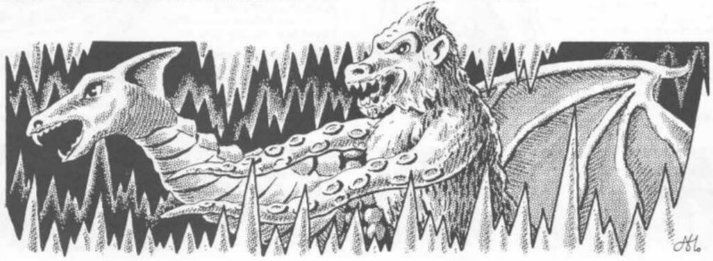
The Denzellian from the classic Fiend Folio monster collection showed up in my google+ feed this weekend. People were debating whether or not it was “ripped off” from Star Trek. I happened to recognize this as one of Lewis Pulsipher‘s contributions to AD&D, so I figured… why not ask him about it?!

Here’s what I wrote to him:

This one came up in conversation recently and I saw it was credited to you.

Can I ask… how much of it was inspired by the classic Star Trek episode “The Devil in the Dark”? Also… can you tell us gamers what it was like getting the critter published in a UK magazine and then incorporated into AD&D canon via a first class hardcover…?

I presume this one and the others collected in the Fiend Folio came out of your campaigns. Do you have any stories about that…? Were the Elemental Princes of Evil the “boss monsters” of a dungeon or something else?

And here is his response:

Hi Jeffro,

I don’t recall where the Denzelian came from (or even what it’s like, though I recognized the name). But I played basketball in high school, which was on the same night as Star Trek, and with no TV recording back then, I didn’t see all that much of Star Trek. Nor have I watched much of reruns since, though I did watch the movies. Maybe I got tired of the charismatic sort-of-Paladin CPT Kirk talking the bad guys into failure or peacefulness (seemed to happen enough to be called a formula).

I have no idea what that episode was about. I doubt the monster was ST inspired.

My monsters got into the Fiend Folio in a simple way. There was a general call for submissions, but I wasn’t interested. I’d submitted some monsters to White Dwarf magazine (and they’d already used some I wrote). I was in the Games Workshop offices one day (I also designed their first boardgame) and Steve or Ian asked me if they could use some of the monsters in FF. I said, OK, if I get a free copy. I didn’t think any more about it until the FF appeared. It’s nice to have my name in it, even though it tends to silly monsters (Don Turnbull’s point of view, that, he was the editor).

I used many of the monsters in my own play, but not the Princes of EE. My campaigns were relatively low level, someone who reached 10 or 11th level was extraordinary – but not really up to the Princes. So as far as I know I made them up just for the heck of it.

I did run into the fire prince once as a player. We were 9th-11th level. We fled “posthaste”.

And I had one character who lost an eye to one of my monsters. Man, it’s not exactly fun running into your own monsters.

I have never thought in terms of “boss monsters” in D&D, that’s a video game mentality. I tended to use lots of monsters (with several different kinds) at a climax rather than one super monster “boss”. It varies, of course. But in D&D, unlike video games, if you die you don’t have a “save game” to go back to; video game bosses are designed to kill you many times before you succeed. Can’t play D&D that way.

Lew

Stormbringer Link Roundup

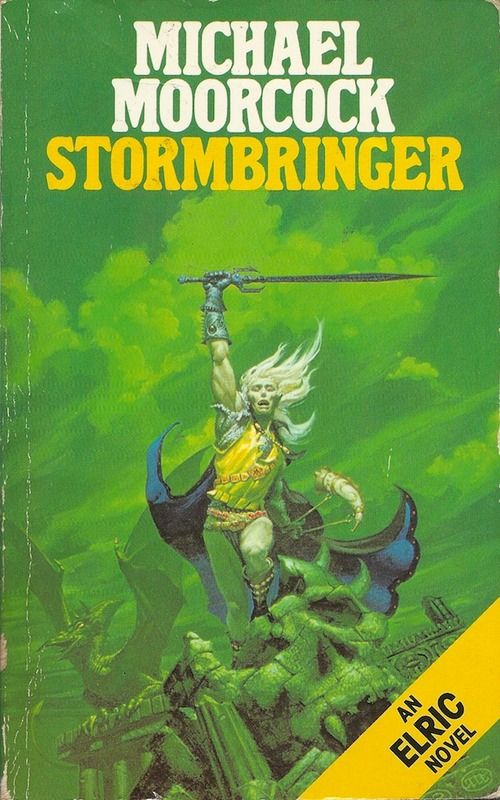
There is a whole lot about AD&D that goes right past people when they sit down and actually tried to play it. Everyone ignores different sections of the rules and glosses over a great many oddities when they set out to create their own campaigns that fit with how they assume fantasy actually ought to work. For those of us that interpreted the game through a Tolkienish lens with no familiarity with the Elric stories, I think whole swaths of the game came off as strange and even wrong, something to be cleaned up in actual play.

But the alignment system in general and having stats for gods and devils in particular isn’t is crazy as you’d think. AD&D alignment corresponds to entire planes of reality, each peopled with their own strains of monsters and gods. To make these odd game elements awesome in the Moorcockian sense, you really need to make them a central element of your campaign, impacting both the magic system and domain level play. One thing’s certain: the results of this sort of play will not at all be “Tolkienesque”.

But yes, AD&D cosmology and devil lore do come from Stormbringer. When Gygax wrote in the Monster Manual that “it is possible to destroy the material form of a greater devil or duke of Hell, but such creatures can not actually be slain unless encountered and fought in Hell or those lower planes adjacent to it”, he was definitely thinking of this book!

More on all this here:

RETROSPECTIVE: Stormbringer by Michael Moorcock

Tor.com — “When Moorcock has a fleet of ships on the horizon, it’s not just a fleet of ships, its 40,000 undead magic-imbued ships. When Elric finally rescues his beloved, it’s not a mere victim of kidnapping he finds, but rather his wife as a bloated demonic worm monster who throws herself on his sword so as not to live such a tortured existence. When Elric dies—well, he doesn’t really, as the struggle for Eternal Balance never ends.”

The Independent Review — “I’m really tired of reading about Elric of Melnibone, and even more tired of writing about him, so here’s my summary of Stormbringer: not fabulous. It felt much too long, and the demon sword killed far too many of my favourite characters for me to enjoy it. But, in a way, I understand that the series really couldn’t have ended any other way.”

Tor.com — “In the first half, we at least have the gratification of watching Elric rescue his wife, getting not one, but two ‘Did You Just Punch Out Cthulhu?’ moments (one with the aforementioned dead god, and one with no less than three Chaos Dukes, including Elric’s own fickle erstwhile patron, Arioch), and a daring escape from Jagreen Lern’s flagship. But once the deaths start piling up in the second half, the grimness becomes absolutely relentless. Not a single Young Kingdom can resist the conquest of Chaos and each is absorbed into its terrifying, seething mass.”

Grognardia — “What made Stormbringer so special to me, I think, was not its rules — though I do think that Basic Roleplaying is well suited to Moorcockian pulp fantasy, moreso than to RuneQuest in my opinion — but the sense it conveyed, just asCall of Cthulhu did, that, though based on someone else’s world, that world now belonged to you. I can’t quite put my finger on how and why the game achieved this, but it did so effectively and that’s why I still pine for the chance to play it after all these decades. Stormbringer is a rare RPG whose succinct, elegant rules feel complete and whose setting feels gloriously incomplete, demanding that the referee and players fill in the blank spaces with their own creations.”

Design a site like this with WordPress.com
Get started