Jeffro's Space Gaming Blog

Microgames, Monster Games, and Role Playing Games

Monthly Archives: September 2015

Something Happened

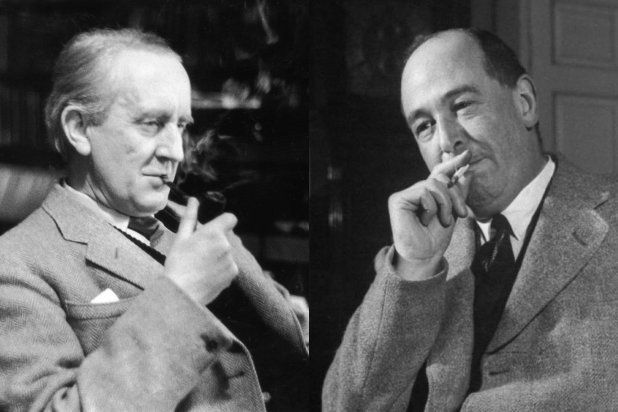
Well, a lot of things happened really. Myself, I blame the loss of cigarette advertising. Other people blame Waldenbooks and the decision of publishers to drop their backlists. This caused authors ranging from Andre Norton to Fritz Leiber to lapse into obscurity when just a decade before that, A. Merritt would have been on the shelf side by side to Roger Zelazny. Through these changes, J. R. R. Tolkien and C. S. Lewis became the starting point for most peoples’ journey into fantasy fiction… and as good as those guys were, they were not necessarily the default heavyweights for fans in previous generations. Today, you can expect to find maybe about four books at Barnes & Nobel that could solidly be considered to come from the Appendix N.

With that in mind, check out this brief exchange from Google+ yesterday:

Ron Edwards: For a while I kept a collection of the times I’d read “like Tolkien / Tolkienesque,” or “like Howard / Howardian” accompanied by descriptions which had no relation whatsoever to the author mentioned, until I realized I was depressing myself.

Jeffro: Yes! That is exactly what I have been shocked to find– just how deep that goes. Reading Dunsany and Anderson, you see very quickly just what it was that gets left out of our eighties era “Tolkienesque” stories. The scope of and the variety of Howard’s Conan stories is so much greater than later “sword and sorcery” tales that are laid to his feet. And most of the time when people say “Lovecraftian” they really mean “Derlethian”. Rpg’s haven’t, in practice, preserved the spirit of these authors’ works– instead they’ve formalized the derivative stuff in their name.

Ron Edwards: thousand plusses

Neal Durando: Second this. Very excellent insight, Jeffro.

Jeffro: I’m sure I picked up the idea from Ron at some point. What I didn’t realize at the beginning is that the survey would provide evidence of the pattern occurring across more subgenres than what most people would have anticipated.

Probably my favorite thing about the Appendix N authors is the extent to which they defy genre conventions. When they were writing, there was no such thing as “standard” or “normal” fantasy. As such, there is a freshness and a degree of individuality that I just don’t see in more recent works. These people were writing fantasy when there really wasn’t such a thing as fantasy, yet!

Sign of the Labrys Link Roundup

I think a lot of us grew up with conception of fantasy as being more or less along the lines of Tolkien, C. S. Lewis, and D&D. Some people would go on from there to pick up guys like Robert E. Howard and Fritz Leiber. And those swords and sorcery guys… I always got the feeling that they were hip to something cool that I knew nothing about. I could tell from what I picked up from their gaming that they just had completely different notions of how fantasy ought to be conceived.

And while that sword and sorcery had a lot going for it and could be so much more inspiring than the tedious Dragonlance and Forgotten Realms books that flooded the market about the same time that Leiber’s backlist was dropped by publishers… there was really so much more that we missed out on. It didn’t have to be that fantasy would settle successively on these two strange attractors of swords and sorcery and the Tolkien pastiche. There was a whole lot of other ways to do this stuff!

So I really like the weird stuff on the Appendix N list. Vance’s Dying Earth stories are really out there. And while Zelazy’s Amber, Moorcock’s Hawkmoon, and Farmer’s Tiers books all had some really strange stuff in them, de Camp and Pratt’s Carnellian Cube really went beyond all those on an even more fundamental level. But for weirdness in the Appendix N list, there is one book to rule them all. It also happens to be among the most influential works and the least appreciated. So given all that, I’m really excited to roll out this week’s Appendix N post. Here it is:

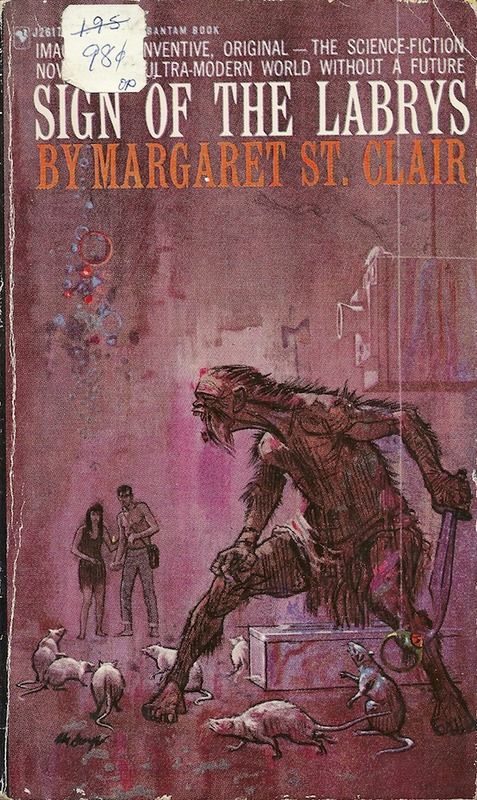
RETROSPECTIVE: Sign of the Labrys by Margaret St. Clair

Blog of Holding — “It is interesting to note that just going down a set of stairs doesn’t guarantee that you’re going into a deeper “level”: a complex that’s 150 feet deep, and composed of several tiers, can be considered a single level if it’s part of the same ecosystem. And that is, I think, how early dungeons were designed. Each level was its own conceptual unit: it might or might not be composed of several floors. The author goes on to explain something else puzzling about Gygaxian dungeon design: levels aren’t always stacked one above another.”

Cloggie — “It is not even half as lurid as the blurb made it out to be. Sign of the Labrys is in fact a solid old-fashioned science fiction story. It’s pretty well written, better than the standard of the time. Most pre-New Wave science fiction writing is somewhat bland: the writing is there only to further the plot or to show off as efficiently as possible the neat idea the writer has thought of. In contrast, St Clair’s writing is almost lyrical in places, a pleasure to read. She has also spend enough time on characterisation to make her protagonist come to life.”

The Caffeinated Symposium — “Attitudes aside, this is what struck me about the characters in The Sign of the Labrys. It was as if they were wandering through Castle Greyhawk with only their wits, a single charm person spell, and a couple of lanterns to throw. The labyrinth in the novel is, in many ways, an archetypal megadungeon. It is laced with secret doors, special rooms, various servitors and defenders, and all sorts of interesting tricks and mechanisms. It is huge and fathomless and full of mysteries.”

The Alexandrian — “In short, Sign of the Labrys reads like a strange hybrid of Dungeons & Dragons and Metamorphosis Alpha. Here we find a clear predecessor of Castle Greyhawk: A multi-cultural, subterranean menagerie laid out in a pattern of levels and sub-levels connected by both the well-known thoroughfares and a plentitude of secret passages and hidden ladders. This, by itself, would have made Sign of the Labrys a fascinating and worthwhile novel for a D&D afficionado like myself. But I also found the novel to be very entertaining in its own right. Addictive, in fact. It’s got a page-turning, pulpy pace mixed together with some nigh-poetic language and a strange, enigmatic mystery that leaves you yearning to know the answer.”

Science Fiction and Other Suspect Ruminations — “Unfortunately, Sign of the Labrys is a disappointing read. The post-plague world is dark and creepy and for the first half an uncanny (palpable) tension permeates. But, ultimately the fantastic setting, revisionist stance on the normal pulp gender dynamics, are weakened by a disjointed (verging on amateur) narrative filled with Wiccan “craft” practices and references. As other reviewers have pointed out, one could easily substitute the Wicca magic with the pulp SF staple “psi-power” and I agree completely.  I suspect Margaret St. Clair felt more comfortable with the short story form.  Sign of the Labrys has all the same flaws as other works produced by short story writers who tried their hand at novels in the 50s and 60s (Robert Sheckley comes to mind). Individual scenes are transfixing but the transitions, characterizations, and thrust of the work all verge on inarticulate.”

KIRKUS — “She and her husband led a comfortable life in California, where they owned a house with an extensive library, gardened and became Wiccans shortly after its introduction in the 1950s.”

SUVUDU “Sign of the Labrys is such an odd novel, even by the standards of the sixties. It’s brilliant, have no doubt, but it’s not like anything I’ve ever read. It’s an occult work of science-fiction/fantasy.”

Semper Initiativus Unam — “St. Clair’s book Sign of the Labrys was important in creating the concept of the dungeon as an underground world.”

REVIEW: Saving Fang from the Pits of Morgul by Ken St. Andre

This is one of those things that just needed doing. I mean… can you imagine an edition of Tunnels & Trolls not being supported with solitaire adventures? I know, shudder to think, right? Well, thankfully with the “Deluxe” edition being in the works these past few years there was plenty enough reason to get this one nagging detail taken care of. And by the progenitor of this iconic game no less!

So… how is the only adventure designed especially for the first edition of Tunnels & Trolls? Well, in keeping with the line’s traditions it’s lavishly illustrated. Even better, it’s loaded with dash and charm. And I must say, the gratuitously captivating “Cherry” adds far more than her share of pep to the proceedings. But the best thing about it is that it does a great deal that the monstrously large Deluxe edition of the game does not do:

  • First, it takes you into Troll World and gives you a glimpse of the city of Khosht and what it’s like adventuring in its vicinity. After reading in the Deluxe rules that this was the first city developed for the game and that it was even the city that got burned down via the premise of Metagaming Concepts’ Monsters Monsters!, I have to say that I’m thrilled to have (in effect) gotten a guided tour of the place from Ken himself.
  • It illustrates how a Tunnel Master can use a couple of higher level non-player characters to throw one or two novices into more of an epic scenario. You don’t have to play out the details of their actions; you can use them to provide a frame that allows the low level characters to focus on the part of the adventure that depends on them! This is a neat trick and I’m glad to have it incorporated into my game mastering arsenal.
  • It shows how combat situations can be broken down into multiple parallel encounters. The various editions of Tunnels & Trolls suggest this sort of thing, of course… but it’s great getting a glimpse into how an old pro applies these suggestions in an actual gaming situation. I am much less likely to simply total and compare the combat results of the players and the monsters now.
  • It has both a set of fully stated and defined monsters and some fleshed out NPC characters to go with them. ( know… it’s crazy to me that the big Deluxe book doesn’t quite do that, but the ghouls, skeletons, zombies, and necromancer are really useful to someone that is flat new to the system.

Ken St. Andre is a very gracious referee. He’s no Monty Hall, sure… but he allows players of this dungeon to take whatever equipment they want from the lists in the first edition rules. Even better, he grants players of the Rogue character type the option of selecting any first level spell they like right from the beginning. (That’s really nice of him. While that is standard operating procedure in the Deluxe edition, in the first edition rules there’s no telling how long it’d take a rogue player to scrape up enough funds to convinces a wizard player to teach him something…!)

Playing this out strictly by the first edition rules, I am convinced now more than ever that the streamlining of the Deluxe edition is (for the most part) spot on. In my game, I dutifully looked up the monsters’ dice ratings each time I did damage to them. (The dice progression is not only much more predictable in the latest version of the game, but they keep their dice rating throughout the combat, so there’s nothing to rethink there.) I also applied the rule of the monster only getting one quarter of their rating in adds starting with the second combat round. When the monster dropped below ten hit points, I was even rolling zero dice for them. You just don’t lose anything by dropping this sort of extraneous detail.

Now, I’ve lost many a player character in these Tunnels & Trolls solitaire adventures previously, so I expected the worst. I probably didn’t have to be so paranoid, but I took every measure to see to it that the guy I rolled up was competitive. In this case… that meant playing an elf. Here he is if you want to use him in your game:

ST 12
IQ 14 + 7 = 21
LK 15 + 7 = 22
CON 10
DEX 8 + 4 = 12
CHR 6

Type: Rogue
Kindred: Elf
Level: 1 (First Edition rules)
Weight Possible: 1200
Experience Points: 0
Languages: Common, Elvish, Trollish… and seven others?!
Combat Adds: 10

Spells: Take That You Fiend (costs 6 strength to do damage equal to IQ)

Bastard Sword (Weighs 75, does two dice damage… may spend one strength to go two handed and do three dice damage instead.)
Dragon Venom (Weighs 10, 20 applications, quadrupals edged weapon damage before adds.)
Light Crossbow with 20 bolts (Weighs 105, 2+3 damage)
Chain Mail (Weighs 500, takes 5 hits)
Steel Cap (Weighs 25, takes 1 hit)
Shield (Weighs 300, takes 2 hits)
Total Weight: 75 + 10 + 105 + 500 + 25 + 300 = 1015

Now… as you can see here, going with the elf kindred is basically just free attribute points. In this case, the bump in Luck even went straight into my combat adds! The lack of a WIZ attribute meant that the same resource that paid for exerting myself in combat was paying for my spell. And yeah, I did end up using the bastard sword two-handed on occasion because that extra die in combat was well worth the fatigue it cost. And finally… I did go the full munchkin and took in the Dragon Venom with me. I wasn’t sure how well that stuff would have worked against undead, so I didn’t actually use it in play… but man, that stuff is awesome. Of course, that one item was worth more than the loot I took out of the dungeon, but seriously… what adventurer is going to turn up his nose to such gifts?

One thing I wasn’t clear on was how the armor provided protection. Now… my assumption is that it works like damage resistance in GURPS. But the first edition Tunnels & Trolls rules talks about how they merely add to constitution. The implication seems to be that the armor is destroyed as soon as the player applies his damage to them! Is that really the intent of the game designer…? I’m not really sure. If it is, adventurers are liable to go through a lot of armor!

Now… I gotta say one thing about Tunnels & Trolls combat here. It really seems to me that a lot of the times in one-on-one combats, it’s really only going to turn out one way. In GURPS, anybody can get lucky and do serious harm even to a Navy SEAL. But the three fights I played out when I ran myself through this one…? I don’t think I was ever in much danger. I think some of the issue with this would be ameliorated if the monsters in a situation were diverse and the players had to allocate their characters to different combats without knowing the exact ratings that their foes had. But still… this is very different from Moldvay Basic D&D where the players can be outclassed, but gain initiative, drop a single foe, and then watch the bad guys flee due a failed morale check.

And another thing… the “big gun” spell of first level Tunnels & Trolls is not an “I win button” like D&D’s Sleep. It’s more like a bigger better Magic Missile! The tone of the gameplay is very different as a consequence of these contrasting design choices.

As friendly as the Deluxe rules are overall, I have to say that playing this solitaire makes me a lot more comfortable with the idea of running the game. Looking at the notes for running this as a GM adventure, I think this is probably a better introductory scenario than what is included with the big fat rule book. (Note that the stats in the back are all for Deluxe edition anyway, so the designer may well have anticipated this particular use case!)

And while I’m glad I gave first edition a shot, I can say that I’m sorry to put the spartan spell descriptions and incomprehensible “Advanced Weapons Chart” behind me. On the other hand, a pruned down version of the Deluxe edition’s weapon list might be a good idea. The weapons and armor lists on the new GM screen looks a lot better to me if I’m going to be walking new players through the process of creating characters…!

There were a couple of errors in this product. In my play-through, I went to a location where I got my weapons back even through I had never lost them. Also… the experience point award for the monsters looked different from what the rules seemed to indicate. And there is a magic item in this thing that is not completely defined and which doesn’t come with an appropriate first edition style experience point award. In fact… there is one section that describes some of its effects… but you cannot get to that location of the text! This did not ruin things for me, though… and given how good everything else about this adventure is, I can still recommend it for people that are just now breaking out their brand new Deluxe Edition rule books. Experiencing the iconic city of Khosht through the virtual refereeing of the system’s original designer is well worth the price of entry. And of course, I’ve already raved over the value of the first edition reprint.

So check it out!

The big puzzle with some of these classic solitaire adventures is figuring out the best combination of equipment purchases to optimize your chances. I attempted to do that before I’d read that Ken was giving me whatever I wanted. For what it’s worth, I don’t think I would have had a harder time getting through things without the fancy gear. Here’s the stuff I originally picked out:

Weight Carried: 220 + 250 + 25 + 1 = 496
Gold: 140 – 75 – 50 – 10 – 5 = 0
Battle Axe (4 dice)
Leather Armor (2 hits)
Steel Cap (1 hit)
Curare (3 applications)
Now Would Be a Good Time to Invite the Thought Police to Leave Our Hobby Alone

You know, I got pretty upset when OBS banned their first game last year. I did write to them, but I did not really do anything beyond making a few snarky blog posts. However, this lack of conviction with regards to free expression seems to be growing to the point where things are liable to slip even further at an even more accelerated rate. In my opinion, this will directly impact the quality of independent game design efforts and potentially even cause us to lose some of our most insightful creators. People don’t get into rpg design because of the money– they do it because they have complete freedom to express themselves. Dilute that freedom far enough and they may well find another hobby to devote themselves to.

I really don’t want that to happen. I don’t think I am alone, either. I am therefore instituting Operation Roiling Mumble. Here is how to participate:

  1. Read Steve Wieck’s post on the new Offensive Content Policy for OneBookShelf.
  2. Be genuinely concerned with where this could lead and with how it could impact the rpg hobby.
  3. Contact OBS at custserv@onebookshelf.com or stevew@onebookshelf.com and let them know what you think.
  4. Share your email with me either in the comments here or privately at autoduelist@gmail.com so that I can get a notion of just how big the pushback is.

To be clear, I am not threatening a boycott if they fail to run their business the way that I think they should. If you feel that way, that’s fine. If you don’t, that’s fine, too. At this point, I am only interested in increasing the volume of negative feedback for Steve Wieck’s proposed policy.

How many “free speech nuts” are active in the rpg hobby right that would take the time to write an email about this? I don’t know! But I would like to think that there are more people like that than, say, the number of people that made it a point to walk out on the Ennie awards ceremony this year. If you are the sort of person that would like to do something to preserve freedom of expression, now would be a good time to let Steve Wieck know that we could really do without him inviting people to be offended at our games.

“Without the ability to freely create, and freely reach people who might be interested in those creations, participation in this hobby and this industry is simply not worth doing.” — James Raggi

“When the Gamergate card game was banned, Steve Wieck boasted about how Onebookshelf had only ever had to ban one thing ever, and hey, it was okay because it was just Gamergate, the maid rape and crack whores were safe. Well, first they came for Gamergate, now they’ve come for Tournament of Rapists. Because that’s how fucking far through the looking glass we are. Yeah, the inoffensive card game satirizing the events of the first few months of Gamergate was banned first, but now Onebookshelf has gone down the ‘We’ll ban offensive stuff when we see it’ slippery slope that everyone said would happen because of some tacky open d20 product that got brigaded.” — Cirsova

“I tried, well beyond the call of courtesy, to speak with Mr. Wieck about the choices he was making, in selling his site over to the would-be censors, the pseudoactivists of the hobby who demand the RPGnow and DrivethruRPG should have to appease their growing demands that anything they personally find offensive be censored, and be censored immediately. He has made it clear that he has no interest in reasoning with anyone who supports freedom of speech, and everything I’ve seen indicates to me that he is determined to go forward with a policy whereby anyone who claims offense will be able to have a product IMMEDIATELY pulled from OBS’ shelves at the click of a button.” — The RpgPundit

Comparing First Edition Tunnels & Trolls to the Deluxe Edition

“Please realise that more than almost any other game still in commercial production, Tunnels & Trolls (and MSPE) is flexible and utterly independent of endless rules books; Ken, Liz, Mike and company having delivered all that you would ever need to stimulate your group’s imagination while laying a solid foundation off which to build your own games.” — Kyrinn S. Eis

It really does surprise me how excited I am about this game. It’s exactly what I needed in my life all those years ago when I was struggling with Gamma World third edition as a twelve year old that didn’t quite comprehend role-playing games. As much as I love that dear old train wreck, it seems to me Ken St. Andre had a much better grasp of how to take zany, wide open wa-hoo adventure and put it in a format that a novice could actually run and comprehend.

There is very little in the new Deluxe edition rules that I feel that I absolutely must change before I could play it. Honestly, some of the nuance of first edition hurts my head and I just don’t always want to dig back into it to figure out what exactly they were doing back in the seventies. However, as far grasping the spirit of the rules goes, I have to say… a close reading of first edition really is essential– especially given just how many things have disappeared from the latest version of the game. In fact, there are places where I think some unnecessary interpolation is required in the Deluxe rules… but the original game goes a long way towards filling in the gaps.

Here then are a few comments on first edition that I noted after giving both rule sets a close reading back to back:

  1. The first section of the rules after the introductions is some advice on how to “dig” a dungeon. The original Tunnels & Trolls was a game for people for whom the $10 and three booklets of OD&D was too much complexity and too much expense. It was a game for people that had no experience with either Avalon Hill or miniatures gaming. The use of only six-sided dice was an intentional design decision that meant that it was a game for all the people that would have been unable to get ahold of set of fancy polyhedral dice. While it was more comprehensible to a wider audience than original D&D, nevertheless… it still required a great deal of creativity to run. The referee was required to create an entire adventuring scenario as a first order of business– and with only the most spartan of advice to go on!
  2. Just how exactly a rogue gains his spells is somewhat ambiguous and varies across editions and gaming groups, but the intent of the original rules seems to be the rogues buy spells from player character wizards for whatever price they ask for!
  3. Tunnels & Trolls referees could not afford a fancy Monster Manual like what became de rigueur for that other game. Monsters could be created with the same attributes as player characters or they could be defined with a single number: the Monster Rating. There was no hard and fast system for how to do it– but there was a whole lot of enthusiasm for doing it however you wanted. One odd idea here is it was taken for granted that they way monsters were developed or that monster ratings were interpreted should change as after the first level of the dungeon. For instance, monster damage results might be multiplied by their dungeon level so that people would not have to roll fist-fulls of dice in order to keep up with them.
  4. One critical change: the monster originally got half of its Monster Rating as “adds” on the first round… and only a quarter of its remaining hit points on subsequent rounds. Presumably its dice would have been dropping as well, because they could not defend themselves when they got below ten! While no one has been keen on keeping up with this amount of math and chart lookups– the dice the monster gets for its monster rating is kind of wonky– nevertheless, having a cutoff point where the monster will beg for mercy and possibly even ask to become a henchman is a nuance that’s now lacking from the Deluxe Edition. (Note that a player character’s charisma would come into play when a subdued monster attempted to revolt against them.)
  5. Combat was assumed to be “theater of the mind”, but while it was even more simplified than the system in even the simplest editions of D&D, it nevertheless was not assumed to be some sort of die rolling contest. It was intended that the referee was to make many common sense rulings about how many separate melee battles would go on at once, when and for how long missile weapons would be allowed to fire, and what circumstances pole arms would actually be relevant and effective.
  6. There was a system for Monster reactions in the original game… and it did not survive the decades of development to make it into the Deluxe edition. (!!) While it did not include any modifiers for player characters’ charisma scores, it did include a range of possible outcomes that included the monster going berserk to parlaying to running away.
  7. The combat adds rules were very different under first edition. In the first place… there was no Speed attribute back then. Secondly, there were separate ratings for melee and missile combat. Thirdly, there was a penalty to the adds if the relevant attributes were less than nine. And finally… wizards did not get combat adds! (Under the Deluxe rules, a wizard loses the benefit of his adds if he elects to use a weapon larger than a staff or dagger.)
  8. The original rules for awarding experience points are instructive. The most obvious difference is that “xp for gold” was in force in the earliest edition and then dropped from the Deluxe rules. Unlike D&D’s occasionally byzantine rules regarding “xp for selling magic-items”, first edition Tunnels & Trolls gave out experience points for simply recovering them. Finally, the “xp for saving rolls” was originally developed when making such rolls meant that something bad was coming your way. When using saving rolls as a general task system, it doesn’t make as much sense to award experience for them. (And note that in the original game, if you failed a saving roll and took damage, you earned experience equal to the saving roll times the total damage taken. That’s kind of epic, really…!)
  9. The biggest change from first edition to Deluxe edition is that in the new game, characters’ levels are a function of the their highest attribute. The original game had it be a function of earned experience points. Upon leveling up, the player could raise an attribute by a given fraction of the new level number. In the newest edition, experience can be spent to any attribute by a point… and they can get really, really large…! (I really wonder how that will work in actual play over the course of a campaign.)
  10. First edition’s nifty slave and hireling rules are gone in the Deluxe edition.
  11. In first edition, monsters gained experience points, too! (Why have I not ever thought of that?!)
  12. The rules for creating new spells are completely wide open under the Deluxe edition. Originally they cost 1000 gold per spell level or (strangely) nine tenths of the wizard’s strength. (?!)
  13. In the Deluxe edition, spells have both an IQ and a Dexterity requirement. Originally they were limited only by IQ. The DEX requirements for spells were much more modest in the beginning. They started at 8 for level one and went up a point for each level thereafter. In comparison to that, the IQ requirements increased somewhat more steeply. (Also… there was no WIZ attribute and spell power was taken against Strength instead.)
  14. There are many more poisons in the Deluxe edition. (This was a central part of actual play back in the day, so don’t skip it.)
  15. It’s surprising, but the first edition had elaborate rules for weapon composition and breakage.
  16. There were relatively detailed rules for how to deal with berserk party members that continue attacking their friends after the monsters are defeated. In the original rules, the choice of whether to go berserk or not was made when looking at their damage throw. Also, the strength cost was two under first edition and has become 1d6 in the Deluxe edition. Finally… the rules for monsters going berserk was also different.
Design a site like this with WordPress.com
Get started